What Google Looks for in a Brand New Site
When you launch a new website, Google has zero data about you. No crawl history, no backlink profile, no brand signals. Your site sits in what SEOs call the sandbox - a period where Google observes before it trusts.
During this phase, Google evaluates three things:
- Can Google find your content? If your pages are not indexed, they cannot rank. Indexing is the first hurdle for every new domain.
- Does your content answer real questions? Google ranks pages that match user intent. A well-structured article that solves a specific problem will outperform a generic page every time.
- Does any trusted site vouch for you? This is the trust signal. Google uses backlinks from established domains as a proxy for quality. A new site with zero backlinks stays in the sandbox longer.
You cannot speed up the timeline significantly, but you can give Google everything it needs from day one so the process starts immediately rather than months later.
Start With FindGreatSites - Your First Trust Signal
The fastest way to cross the trust threshold is to submit your website to FindGreatSites. Each listing on our platform includes a permanent dofollow backlink from a DR68+ directory. For a brand new domain with zero authority, that single link tells Google an established site has reviewed and accepted your project.
- Instant dofollow link. The link goes live when your listing does. No waiting, no review queue.
- Permanent placement. Your listing stays indexed as long as your project is active. That backlink does not disappear.
- Listing visibility. Your project appears in our directory alongside other launched sites, giving you discovery traffic while your SEO builds.
Create your account and submit your site. Five minutes is all it takes to go from DR 0 to having an indexed backlink from a trusted directory.
The 3 Pillars of Early-Stage SEO
Once your first trust signal is in place, focus on three areas. Every new site that ranks well within 6 months gets these right.
Pillar 1: Targeted content. Do not write about everything. Pick one topic and own it. A site with 20 articles on "SaaS customer onboarding" will rank faster than a site with 100 articles on random SaaS topics. Write for the specific keywords a new site can win - long-tail queries, question-based searches, and niche modifiers like "for beginners" or "in 2026."
Structure your content in clusters: one in-depth pillar page (2000+ words) surrounded by 10-15 supporting articles, each linking back to the pillar. This signals topical authority better than any other content strategy.
Pillar 2: Solid technical foundation. New sites cannot afford technical gaps. Fix these before publishing anything:
- Page speed under 2.5 seconds on mobile
- Mobile-first responsive design
- SSL certificate (HTTPS)
- Clean URL structure without query parameters
- XML sitemap submitted to Google Search Console
- No broken links or 404 pages
Pillar 3: Quality backlinks from free sources. You do not need to spend money. Start with FindGreatSites, then add Crunchbase, GitHub, and LinkedIn. Each platform provides a backlink from an authoritative domain. On a new site, even 5-10 quality backlinks create a meaningful boost because your profile starts from zero.
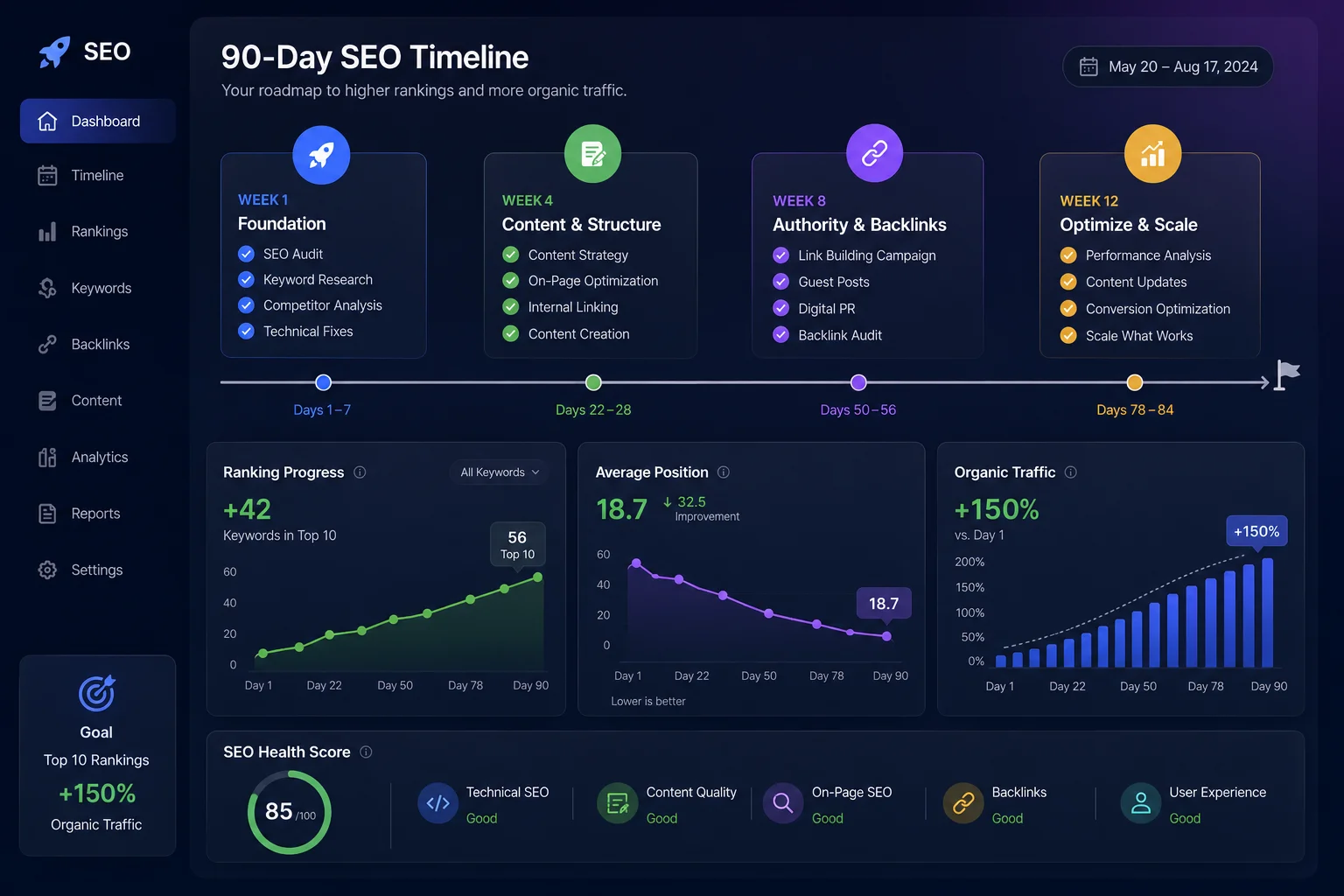
A Realistic 90-Day SEO Calendar
Here is what a new site's first 90 days look like when done right:
Week 1. Submit to FindGreatSites. Set up Google Search Console. Submit your sitemap. Fix technical SEO basics. You want Google to find and crawl your site as soon as possible.
Week 2. Publish your pillar page (2000+ words on your core topic). Create profiles on Crunchbase, GitHub, and LinkedIn for backlinks. Request indexing for every new page in GSC.
Weeks 3-4. Publish 4 cluster articles that support your pillar. Link each one back to the pillar. Continue requesting indexing.
Weeks 5-6. Publish 4 more cluster articles. Submit to free backlink sources. You should have 8-10 free backlinks by now.
Weeks 7-8. Write 2 articles on Medium or Dev.to linking back to your site. These content platforms get crawled quickly and can trigger Google to discover your domain.
Weeks 9-12. Maintain one article per week. Check GSC for indexing issues. Build backlinks consistently. By week 12, you should have 15-20 backlinks from diverse sources and 15+ published articles on your site.
Most new sites following this plan see their first meaningful rankings between months 3 and 6. The ones that publish inconsistently or skip the technical foundation often wait 9-12 months for the same results.
The #1 Mistake New Sites Make
The biggest reason new websites fail to rank is not lack of backlinks, poor content, or technical issues. It is inconsistency.
A site that publishes one article per week for six months outperforms a site that publishes ten articles in one week and then stops. Google notices publishing patterns. A steady cadence signals that your site is active and growing.
Inconsistency also applies to backlinks. Submitting to 20 directories in one week and never doing it again creates a spike that looks unnatural. Spread submissions across weeks. Consistent effort over time builds a profile that search engines trust.
Set a schedule you can maintain. One article and five backlink submissions per week is enough to build meaningful momentum over 6-12 months.
Track What Matters
Do not optimize for vanity metrics. Track the signals that tell you whether your SEO is working:
- Indexed pages in Google Search Console. If Google is not indexing your pages, nothing else matters.
- Average position for your target keywords. Are you moving from position 50 to position 20? That is progress, even if you are not on page 1 yet.
- Referral traffic from your backlinks. A backlink that sends visitors is more valuable than one that only passes authority. Check your analytics for traffic from directory listings and content platforms.
- New backlinks discovered. Use a free backlink checker monthly. Are new sites linking to you? That is the best sign your content is gaining traction.
Start with FindGreatSites today. It is the fastest first step you can take as a new website, and it keeps delivering value as your site grows.